Last reviewed and updated · figures checked against the notified DA of 60% (effective 1 Jan 2026)
Original articles explaining the core concepts behind the 8th CPC pay revision
— the fitment factor, allowance structure, DA merger, and how to evaluate
projections without being misled.
8th Pay Commission: What the Commission Does and Why It Matters
Concept explainer · Updated April 2026
The Central Government reviews the pay, allowances and service conditions of its
employees through a Pay Commission approximately once every decade. The 8th Pay
Commission, announced by the Union Cabinet in January 2025 and formally constituted on 3 November 2025, continues a pattern
that began with the First Pay Commission after independence. Understanding what a
Pay Commission actually does — and what it does not do — is the starting
point for any sensible salary planning.
Pay commissions are not simply about a single salary increase. The commission reviews
the entire compensation structure: how pay levels are organised, what the relationship
between different grades should be, how allowances like HRA and DA should be
calibrated to economic conditions, and how the pension system should function going
forward. The result is a comprehensive set of recommendations that, once accepted by
the government, reshape the pay structure for the next ten years.
Why the Ten-Year Cycle Matters
The interval between commissions is significant because Dearness Allowance partially
compensates for inflation between cycles, but it does not restructure the pay matrix
itself. Over a decade, the underlying structure of pay levels, entry pay and grade
relationships can fall out of alignment with changing economic realities. A new
commission resets that alignment by recommending a fresh pay matrix appropriate to
the current moment.
The 7th Pay Commission, implemented from January 1, 2016, set the framework that
central government employees currently work within. It introduced the Pay Matrix: a
grid of 18 levels, each with up to 40 progression cells. Each cell contains a
specific rupee amount representing the basic pay at that level and progression point.
This replaced the older Pay Band and Grade Pay structure, which many employees and
managers found difficult to interpret without detailed knowledge of the official
tables.
What the 8th CPC Is Examining
The commission's review covers several interconnected areas. First, the fitment
factor: the multiplier that converts an employee's current basic pay into their
starting figure in the new pay structure. Second, the design of the new Pay Matrix
itself, including whether the number of levels changes or whether the increment rate
within each level is revised. Third, the allowance structure, covering HRA
percentages, DA arrangements and transport allowance rates. Fourth, pension structure
for retired employees and their families.
The commission also considers relativities between departments, between civilian and
defence services, and between officers and staff. These internal comparisons are
complex and often contentious, which is part of why the process takes considerable
time from constitution to notification.
Who Is Affected
The 8th Pay Commission covers all central government employees, from multi-tasking
staff at Level 1 through to the Cabinet Secretary at Level 18. It also covers central
government pensioners. State government employees are generally not directly covered
by a central pay commission, but many state governments historically align their own
revisions with central government announcements, often with a short delay.
The most important thing readers should remember is this: until official orders are
issued, every figure you read on this topic — including those produced by this
site's calculator — is a projection based on assumptions. The commission's
recommendations, the government's acceptance, and the final notification are three
separate steps, each of which can modify the outcome. Planning for a range of
scenarios is more useful than banking on a single figure.
The Fitment Factor: The Single Most Important Variable in Your Pay Revision
Mechanism explainer · Updated April 2026
Of all the numbers discussed in connection with a pay commission revision, the
fitment factor is the one that matters most to the largest number of employees. It
is a multiplier applied to current basic pay to arrive at the starting figure in the
new pay structure. Understanding how it works in practice is essential before you
can evaluate any salary projection.
How It Worked in the 7th CPC
Under the 7th Pay Commission, the fitment factor was set at 2.57. An employee under
the 6th CPC with a combined basic pay plus grade pay of ₹10,000 would see that
mapped to at least ₹25,700 at the start of the 7th CPC implementation on
January 1, 2016. If no cell in the new pay matrix matched that figure exactly, the
employee was placed in the next higher cell above the calculated amount. The fitment
factor therefore determined the floor for every employee’s pay revision,
regardless of level.
Allowances, HRA and the revised DA structure were all computed on top of the new
basic pay. The single multiplier of 2.57 therefore had a cascading effect throughout
the entire salary package.
Why the 8th CPC Fitment Factor Is Debated
Employee associations and staff unions have historically lobbied for a higher fitment
factor, arguing that the 7th CPC factor of 2.57 did not adequately compensate for
real-world cost increases over the preceding decade. Their position is that a higher
factor, whether 2.86, 3.00 or above, would better reflect the change in purchasing
power since 2016.
The government’s position, by contrast, tends to account for the fiscal
implications of a large multiplier applied to the salaries of several lakh central
government employees simultaneously. The balance between employee expectations and
fiscal management is one of the key tensions that every pay commission navigates.
Until the commission submits its recommendations and the government issues a formal
notification, no published figure for the 8th CPC fitment factor should be treated
as confirmed. The figures you see in circulation — 2.86, 2.57, 3.00 —
are all scenarios, not announcements.
How to Use the Calculator With Different Fitment Factors
The salary calculator on this site defaults to a fitment factor of 2.86 as a
representative middle scenario, but it allows you to enter any figure you choose.
This is intentional. Rather than presenting a single projection that implies false
certainty, the tool is designed for scenario comparison. We recommend running at
least three scenarios before drawing any conclusions:
Conservative scenario (2.57): The same factor as 7th CPC. Gives
the floor of likely outcomes based on historical precedent.
Middle scenario (2.86): Often cited in discussions. Represents a
moderate upward revision from the 7th CPC factor.
Optimistic scenario (3.00 or higher): Represents strong advocacy
positions. Shows the ceiling of what has been publicly proposed.
The range between these three outcomes gives you a realistic sense of how much
uncertainty is built into any salary estimate. A responsible financial plan treats
the conservative figure as the planning baseline, with the higher figures as upside
scenarios rather than expectations.
An Important Qualification
Even after a fitment factor is confirmed, your actual placement in the new pay
matrix depends on how the new matrix is structured. The commission may alter the
number of levels, the entry pay at each level, or the increment rate within levels.
Your final basic pay is determined by official mapping tables, not simply by
multiplying your current basic pay by the factor. The calculator uses the fitment
multiplication as an approximation to help you compare scenarios, not as a precise
prediction of cell placement.
HRA, DA and Transport Allowance: How Allowances Work and What to Expect
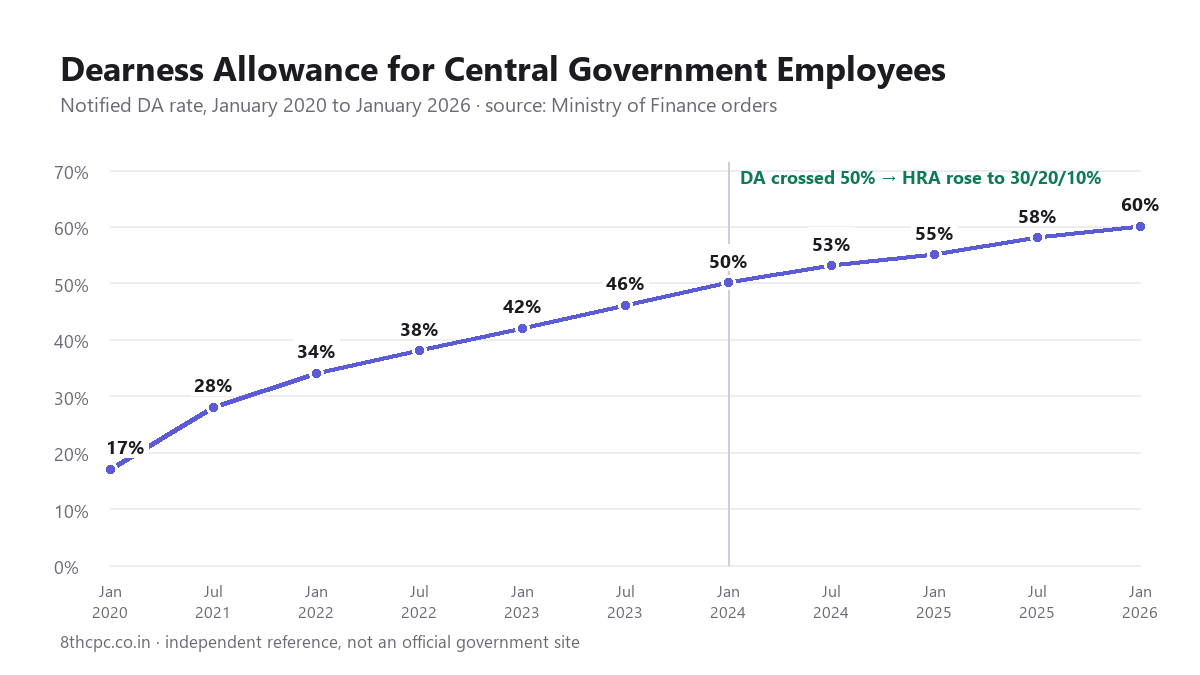
Dearness Allowance rose from 17% (Jan 2020) to 60% (Jan 2026). The marked point is January 2024, when DA crossed 50% and HRA automatically stepped up from 27/18/9% to 30/20/10%.
Allowances explainer · Updated April 2026
Basic pay is only part of the monthly salary picture for central government
employees. Allowances, particularly House Rent Allowance, Dearness Allowance and
transport allowance, can add thirty to sixty percent on top of basic pay depending
on the employee’s level and city. Understanding how each of these is calculated
is essential for reading any salary estimate accurately.
House Rent Allowance (HRA)
Under the 7th CPC, HRA is classified by city type. Employees posted in X-category
cities (which include Delhi, Mumbai, Kolkata, Chennai, Bengaluru and Hyderabad)
receive 24% of basic pay as HRA. Those in Y-category cities (state capitals and
urban agglomerations above a certain population threshold) receive 16%. Employees in
all remaining Z-category locations receive 8%.
Because HRA is a percentage of basic pay, it grows automatically when basic pay
grows. An employee currently at Level 6 in an X-category city earns HRA of
₹35,400 × 24% = ₹8,496 per month. If a 2.86 fitment factor
revises their basic pay to approximately ₹1,01,244, their HRA on the same
percentage would become approximately ₹24,299 — nearly three times the
current amount. This compound effect makes city classification one of the biggest
variables in total compensation.
Previous pay commissions have revised HRA percentages upward. The 6th CPC used 30%,
20% and 10%; the 7th CPC adjusted these downward to 24%, 16% and 8% on the basis
that the higher base pay made the percentage revision equitable. Whether the 8th CPC
raises the percentages again or maintains them is not known until the official
notification.
Dearness Allowance (DA)
DA is not set by the Pay Commission itself. It is revised biannually by the
government based on movements in the All-India Consumer Price Index for Industrial
Workers (AICPI-IW). The DA revision in January and July each year partially offsets
the impact of inflation on fixed salaries between pay revision cycles.
The important point regarding DA in a pay revision context is what happens to
accumulated DA at the time of implementation. In previous revisions, the DA that
had accumulated under the old structure was merged into the base from which the
fitment factor was applied, and DA was then reset to zero under the new structure.
This process is called DA merger or DA neutralisation. If DA is significant at the
time of implementation, the DA merger can materially raise the effective base, which
in turn increases the absolute effect of the fitment multiplier.
The salary calculator on this site does not automatically apply a DA merger because
the exact treatment depends on official orders that have not been issued. If you
want to model the effect of a DA merger, add your approximate current DA amount to
your basic pay in the calculator and observe how the output changes.
Transport Allowance
Transport allowance is a fixed-amount allowance (not percentage-based) that varies
by pay level and city category. Higher levels receive a larger fixed transport
allowance, and employees in larger cities receive a higher rate than those in smaller
locations. Under the 7th CPC, Level 1 to 2 employees in A1 and A cities received
₹3,600 per month, while senior employees at Level 9 and above received
₹7,200 per month, with DA applied on top of those fixed amounts.
Transport allowance rates are typically revised as part of a pay commission
recommendation. The exact revised rates will be specified in the 8th CPC
notification. In the calculator, you can enter a custom transport allowance figure
to model what different rate assumptions do to your estimated take-home pay.
The Practical Impact of Allowances on Total Pay
When assessing a salary estimate, look at the gross figure, not just the basic pay.
For employees in metro cities at middle levels, allowances can represent forty to
fifty percent of the total gross monthly compensation. Focusing only on the basic
pay after fitment understates the full scope of the revision. Conversely, employees
in Z-category locations with lower HRA rates will see a smaller allowance uplift
even if their basic pay revision is identical.
How to Evaluate 8th CPC Salary Projections You See Online
Critical reading guide · Updated April 2026
The 8th Pay Commission generates substantial search traffic and media attention,
which creates a strong incentive for publishers to produce salary projection articles
regardless of whether the underlying figures are reliable. Knowing how to assess a
claim before acting on it is a practical skill for any central government employee.
What a Reliable Projection Includes
A trustworthy salary estimate for 8th CPC should be transparent about its
assumptions. Specifically, it should state clearly:
What fitment factor is being assumed, and whether it is confirmed or speculative
What pay level and cell is being used as the base calculation
Whether current DA is assumed to be merged before the fitment is applied
What HRA percentage and city category is assumed
Whether the gross or take-home figure is shown, and what deductions are included
That the figure is a projection rather than a guaranteed entitlement
Any article presenting a single confirmed 8th CPC salary without citing an official
order or notification should be read with caution. Before any formal notification,
there is no confirmed salary figure to report.
The DA Merger Misrepresentation
One of the most commonly misrepresented aspects of pay revision is the treatment of
DA at the time of implementation. Some projections apply the fitment factor directly
to the current 7th CPC basic pay with no DA consideration. Others include a full DA
merger. These two approaches produce very different results for the same pay level,
and articles that do not state their approach clearly are impossible to verify.
If a projection looks significantly higher than what the calculator on this site
produces, it is likely that the other source is assuming a DA merger in its
calculation. If a projection looks significantly lower, the other source may be
assuming a conservative fitment factor or not including certain allowances. Neither
approach is necessarily wrong, but unexplained differences are a signal that the
assumptions have not been disclosed.
How to Cross-Check a Projection You Find
The simplest way to verify a salary figure you find elsewhere is to enter the same
assumptions into the calculator on this site and check whether you get a similar
result. If the article says it is using a 2.86 fitment factor for a Level 7 employee
in an X-city without DA merger, the calculator should produce a comparable estimate
when you enter those same parameters. If there is a large discrepancy, the other
source has likely included an unlisted assumption or made a calculation error.
Use the range approach: enter several fitment factor values and note the spread of
outcomes. That spread is a more honest representation of what the 8th CPC revision
might mean for you than any single projected figure. Financial decisions should be
based on your current confirmed income, with the projection range treated as
reference information rather than a basis for commitment.
Next Steps
Use the calculator to run your own scenarios
with your actual pay level and cell.
Read the full guide for a step-by-step walkthrough of
how 8th CPC salary calculation works.
Check your pay slip before selecting a level and cell — your basic pay is
clearly printed on it.